Restored saltmarshes lack the topographic diversity found in natural habitat

Peter Lawrence, Graham Smith, Martin Sullivan, Hannah Mossman

Ecological Engineering, 2018
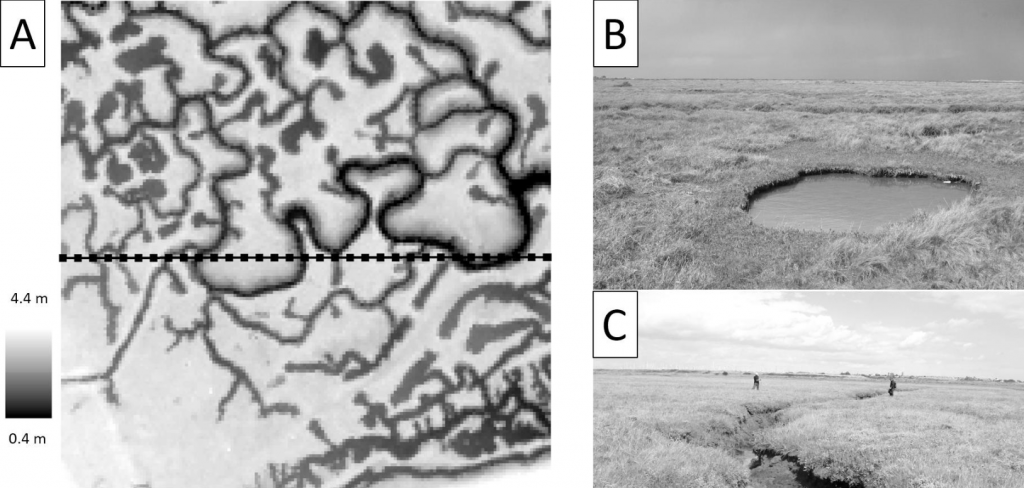
Saltmarshes can be created to compensate for lost habitat by a process known as managed realignment (MR), where sea defences are deliberately breached to flood low-lying agricultural land. However, the vegetation that develops on MR sites is not equivalent to natural habitat. In natural sites, surface topography and creek networks are drivers of vegetation diversity, but their development on restored sites has not been well studied. We investigate the topographic characteristics of 19 MR areas, and compare these to nearby natural saltmarshes (representing desired conditions) and to coastal agricultural landscapes (representing conditions prior to MR). From high-resolution LiDAR data, we extracted values of elevation, six measures of surface topography (although two were later excluded due to collinearity), and three measures of creek density. MR and natural marshes differed significantly in all surface topographic indices, with MR sites having lower rugosity and more concave features, with greater potential for water accumulation. MR sites also had significantly lower creek density. MRs and coastal agricultural landscapes were more similar, differing in only one topographic measure. Importantly, there was no relationship between age since restoration and any of the topographic variables, indicating that restored sites are not on a trajectory to become topographically similar to natural marshes. MR schemes need to consider actively constructing topographic heterogeneity; better mirroring natural sites in this way is likely to benefit the development of saltmarsh vegetation, and will also have implications for a range of ecosystem functions.
Does managed coastal realignment create saltmarshes with ‘equivalent biological characteristics’ to natural reference sites?

Hannah Mossman, Anthony Davy, Alastair Grant

Journal of Applied Ecology, 2012

  1. Coastal saltmarshes provide distinctive biodiversity and important ecosystem services, including coastal defence, supporting fisheries and nutrient cycling. However, c. 50% of the world’s coastal marshes are degraded or have been lost, with losses continuing. In both Europe and North America, there is a legal requirement to create habitats to substitute for losses. How well do created habitats replicate natural salt marshes?
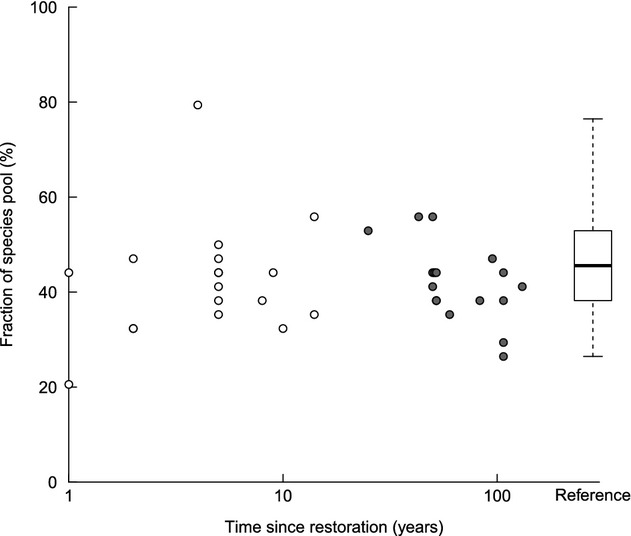
  2. We compared plant communities and environmental characteristics of 18 deliberately realigned (managed realignment, MR – between 1 and 14 years old), 17 accidentally realigned (AR, 25–131 years old) sites with those on 34 natural reference saltmarshes in the UK.
  3. Halophytic species colonized individual realignment sites rapidly, attaining species richness similar to nearby reference marshes after 1 year. Nevertheless, the community composition of MR sites was significantly different from reference sites, with early-successional species remaining dominant, even on the high marsh.
  4. The dominance of pioneer species on the low and mid-marsh may be because, at the same elevation, sediments were less oxygenated than on reference sites. Sediments were well oxygenated on the high marsh, but were often drier than on natural marshes.
  5. Overall community composition of AR marshes was not significantly different to reference marshes, but the characteristic perennials Limonium vulgare, Triglochin maritima, Plantago maritima and Armeria maritima remained relatively rare. In contrast, the shrub Atriplex portulacoides was more abundant, and its growth form may inhibit or delay colonization by other species.
  6. Synthesis and applications. Marshes created by managed realignment do not satisfy the requirements of the EU Habitats Directive. Adherence to the Directive might be improved by additional management interventions, such as manipulation of topographic heterogeneity or planting of mid- and upper-marsh species. However, given the inherent variation in natural saltmarshes and projected environmental change, policies that require exact equivalence at individual sites may be unachievable. More realistic goals might require minimum levels of a range of ecosystem functions on a broader scale, across catchments or regions.